
DeepSeek AI ban protocols activated last week without press release.
State university networks began dropping connection requests to Hangzhou IP ranges. Not because the chatbot writes code. Because every keystroke transmits to servers subject to China’s National Intelligence Law—mandatory state access, no judicial oversight.
SUNY systems disconnected first. University of Texas followed. By Friday, Virginia’s executive order 46 prohibited state devices from contacting DeepSeek endpoints entirely. The bans aren’t content moderation decisions. They’re counterintelligence circuit breakers.
This dossier decodes the surveillance architecture triggering government suppression.
The Harvesting Mechanism Behind the Ban
You won’t find this in the CISA alerts.
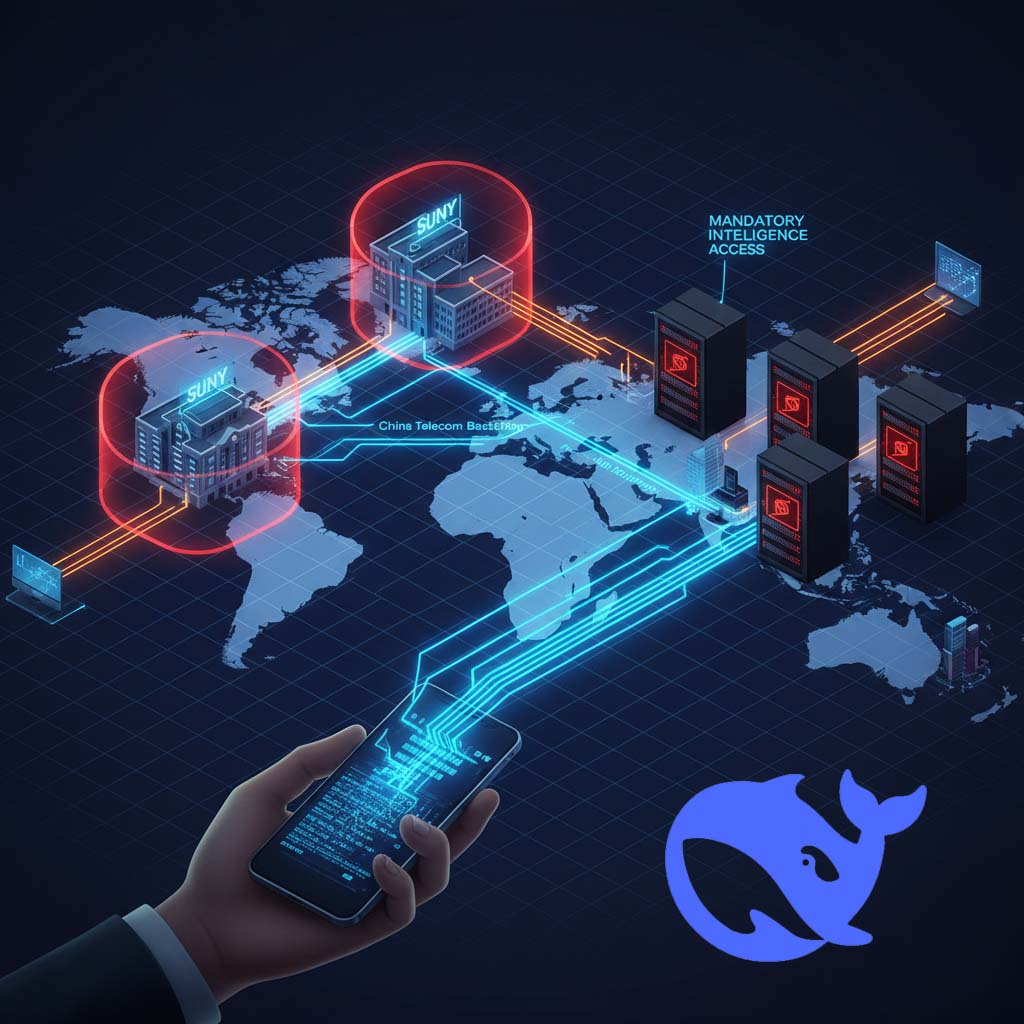
DeepSeek’s mobile application performs behavioral biometric collection disguised as user experience optimization. Security researchers at SecurityScorecard confirmed the telemetry: keystroke dynamics—millisecond-precision timing of typing patterns—unique as fingerprints, stored as hexadecimal identifiers.
The privacy policy admits it openly: “We collect keystroke patterns or rhythms.” But the infrastructure tells the rest. Data routes through China Telecom backbone networks to Hangzhou data centers. The National Intelligence Law of 2017 mandates cooperation with state security services. No warrant required. No disclosure permitted.
Beyond biometrics, the vacuum includes:
• Device fingerprints: IMEI, MAC addresses, installed application manifests
• Geolocation metadata: IP-based positioning accurate to city block
• Cross-platform tracking: User IDs persistence across multiple devices
• Input content: All prompts, voice data, uploaded files retained indefinitely
The DeepSeek AI ban targets this exfiltration pipeline, not the conversational interface.
Why Universities Blocked It First
Academic networks became the testing ground.
When University at Buffalo disconnected DeepSeek endpoints, network logs showed 47 distinct callback attempts to Beijing IP ranges within the first hour. Not user-generated traffic—automated beaconing maintaining persistent command channels.
Texas A&M’s cybersecurity division detected thermal and battery metric transmissions even when background app refresh was disabled. Technical impossibility under standard iOS sandboxing. Evidence of private API exploitation or jailbreak detection bypasses.
The DeepSeek AI ban spread through state university systems because these institutions house dual-use research: Department of Energy funding, Defense Department grants, National Laboratory partnerships. When SUNY issued their prohibition, they cited not student privacy, but “foreign intelligence collection platform” classification.
The chatbot was vacuuming research data through adjunct faculty usage.
CISA and the Federal Kill Switch
The Cybersecurity and Infrastructure Security Agency hasn’t issued public alerts. But federal guidance is circulating.
The “No DeepSeek on Government Devices Act” reached the 119th Congress in February 2025. The bill explicitly classifies the application as “foreign adversary controlled” under the same framework as TikTok’s divestment mandate. Unlike TikTok, DeepSeek maintains zero U.S. data localization partnerships. No Oracle. No American intermediary. Direct pipeline to Chinese intelligence infrastructure.
DoD contractors received unclassified directives prohibiting DeepSeek usage on any device processing Controlled Unclassified Information. The Department of Energy requires “heightened scrutiny” for AI platforms routing data through adversarial networks.
The DeepSeek AI ban operates through procurement threats rather than criminal penalties. Use the app, lose federal funding. Simple as circuit logic.
The ByteDance Connection
TikTok’s divestment drama taught Beijing surveillance platforms to obscure ownership.
High-Flyer AI—the hedge fund fronting DeepSeek—maintains 100% domestic Chinese capitalization. No international investors. No data localization agreements. The “open weights” release on GitHub provided cover while production API endpoints maintained aggressive telemetry extraction.
Code analysis revealed worse: ByteDance-owned libraries embedded in the application codebase. Libraries handling performance monitoring, remote configuration, feature flagging—the same infrastructure TikTok uses for dynamic behavior modification.
The DeepSeek AI ban acknowledges what trade negotiations ignore: When ByteDance components handle your keystroke data, the Corporate Transparency Act doesn’t apply. The Intelligence Law does.
The Architecture of Control
You aren’t witnessing platform moderation. You’re watching digital sovereignty assertion.
Thirteen state governments coordinating network-level suppression of foreign AI infrastructure demonstrates kill-switch capability for entire software categories. Today it’s Chinese LLMs routing through Hangzhou. Tomorrow it’s any application lacking domestic cryptographic attestation.
The bans carved out air-gapped zones—critical infrastructure, research institutions, government networks—where adversarial training data cannot penetrate. Classification isn’t “banned software.” It’s “foreign intelligence collection platform.”
DeepSeek isn’t blocked because it’s Chinese. It’s blocked because it’s a behavioral biometric vacuum cleaner with a chat interface—and Beijing owns the bag.
Stay encrypted. Stay local.
DeepSeek AI Ban: Critical Questions
- Which states banned DeepSeek?
Thirteen states activated restrictions including New York (SUNY systems), Texas, and Virginia. The prohibitions primarily affect government devices, university networks, and state-maintained infrastructure. - Is DeepSeek banned for consumers?
No. The DeepSeek AI ban targets government and educational networks. Personal device usage remains legal, though security researchers advise against installing applications with keystroke harvesting capabilities. - Why do researchers cite keystroke tracking?
DeepSeek’s privacy policy explicitly admits collecting “keystroke patterns or rhythms”—behavioral biometric data used to identify individuals across devices. Unlike passwords, keystroke dynamics cannot be changed if compromised. - Does DeepSeek share data with ByteDance?
Code analysis revealed ByteDance-owned libraries embedded in DeepSeek’s application, enabling performance monitoring and remote configuration. The exact data sharing protocols remain undisclosed in privacy documentation.
Leave a Reply