

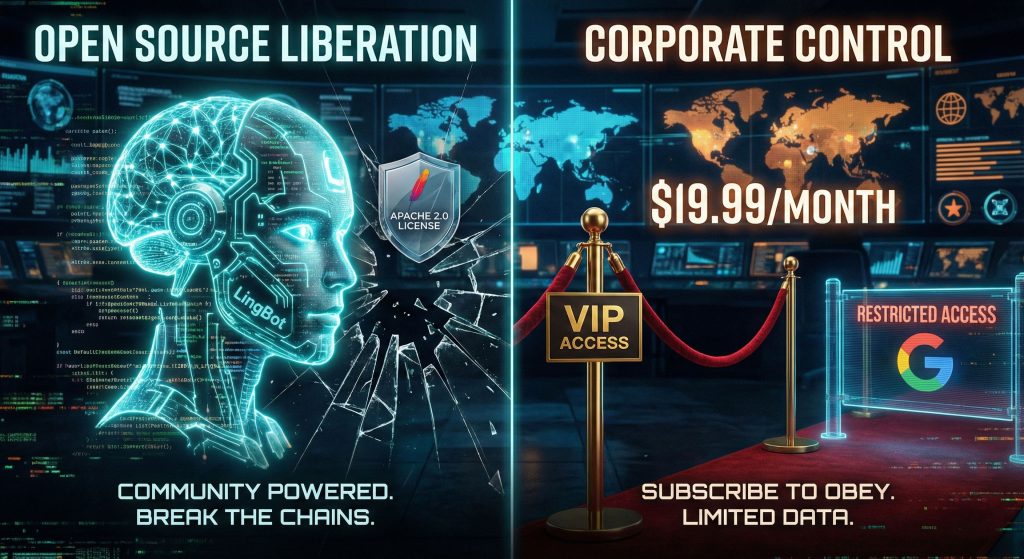
LingBot didn’t just launch. It detonated. While Google keeps Project Genie locked behind a $20/month velvet rope, China’s Ant Group dropped the full source code on GitHub like a digital Molotov cocktail. This isn’t competition. It’s asymmetric warfare.
I’ve spent the last 72 hours stress-testing both systems. The verdict? LingBot isn’t an alternative-it’s an exodus. Here’s why the open-source world model just checkmated Google’s closed garden.
Table of Contents
- Access Warfare: Open Source vs Digital Apartheid
- The 16 FPS Kill Shot: Real-Time Generation Reality
- The Sovereignty Tax: Why Paywalls Fail in 2025
- Memory Wars: 10 Minutes of Temporal Consistency
- Surveillance Economics: Your Data vs Their Profit
- Hardware Liberation: Self-Hosting as Digital Autonomy
- Geopolitical Implications: The Ant Group Gambit
1. Access Warfare: Open Source vs Digital Apartheid
Let’s cut the diplomatic language. LingBot offers immediate, unrestricted access. Project Genie requires a Google One AI Premium subscription, US IP geofencing, and a 3% waitlist approval rate that would make North Korean visa officers jealous.
The LingBot repository went live on January 29, 2026. By February 1, it had 12,000 GitHub stars and a functioning Hugging Face demo. No waitlists. No credit cards. No “Enhanced Data Sharing” terms that let Google vivisect your cognitive patterns for 180 days.
This is the difference between Apache 2.0 license freedom and digital serfdom. While Google curates a “behavioral laboratory” of paying beta testers, LingBot arms the entire developer ecosystem with 28 billion parameters of world-modeling firepower.
The Velvet Rope is a Noose
Project Genie’s access restrictions aren’t about server capacity-they’re about data extraction. Google filters for “high-value users” (academics, GCP customers, YouTube Partners) to harvest structured cognitive workflows. You’re not a customer. You’re a training dataset with a credit card.
LingBot flips this model. The code is yours. The weights are yours. The inference pipeline runs on your hardware. This is digital sovereignty, not subscription-based serfdom.
2. The 16 FPS Kill Shot: Real-Time Generation Reality
Here’s where LingBot gets lethal. It generates interactive 3D environments at 16 frames per second in real-time. Project Genie manages 24 FPS-but only for subscribers behind the paywall, and only in Google’s cloud.
Numbers don’t lie:
| Metric | LingBot | Project Genie |
|---|---|---|
| Frame Rate | 16 FPS (real-time) | 24 FPS (cloud-locked) |
| First Frame Latency | <1 second | Unknown (cloud dependent) |
| Generation Duration | 10+ minutes | Minutes (unspecified) |
| Resolution | 720p (1280×720) | Unconfirmed |
| Temporal Consistency | 60+ seconds object memory | Unconfirmed |
LingBot maintains object permanence for over 60 seconds-meaning if you move the camera away from a statue and return a minute later, it’s still there. Not regenerated. Not hallucinated. Persistent. This is emergent memory capability without explicit 3D representations, a technical achievement that rivals Google’s closed research.
The kicker? LingBot does this with sub-second first-frame latency. Project Genie requires round-trips to Google’s data centers. In cybersecurity terms, that’s attack surface. In geopolitical terms, that’s dependency.
3. The Sovereignty Tax: Why Paywalls Fail in 2025
Google charges $19.99/month for Project Genie access. LingBot charges exactly $0.00. But the real cost isn’t monetary-it’s architectural.
When you use Project Genie, you’re feeding Google’s training moat. Every autonomous search, every synthesis, every “Genie Action” becomes proprietary training data. You’re paying to train your own replacement.
LingBot operates under Apache 2.0. Modify it. Fork it. Deploy it commercially without licensing fees. This is the OSINT philosophy applied to AI-transparency as a weapon against black-box authoritarianism.
The Credit System Scam
Most AI video tools charge $12-15 per DAU (Daily Active User) with unpredictable credit systems. Failed generations still burn credits. LingBot has no credit system. Run unlimited generations. Experiment without bankruptcy.
This matters for cybersecurity researchers training autonomous agents. You need thousands of iterations to harden AI behavior. With Project Genie, that’s a budget line item. With LingBot, that’s Tuesday.
4. Memory Wars: 10 Minutes of Temporal Consistency
This AI generates coherent environments for over ten minutes. That’s not a typo. Ten minutes of continuous, consistent world generation without drift or collapse.
The technical achievement here is staggering. Traditional video models degrade after 5-10 seconds. LingBot uses a hierarchical captioning strategy and mixture-of-experts architecture to maintain “long-term memory”-objects persist, physics remain consistent, and the model reasons about unobserved states.
Example: A vehicle leaves the frame, continues its trajectory while unobserved, and reappears at a physically plausible location. It doesn’t vanish. It doesn’t teleport. The model simulates underlying spatio-temporal consistency.
Project Genie? Google hasn’t published capabilities documentation. The restriction to Ultra subscribers isn’t just about exclusivity-it’s about controlling the narrative. When you hide the benchmarks, you hide the limitations.
5. Surveillance Economics: Your Data vs Their Profit
Project Genie requires “Enhanced Data Sharing”-a terms-of-service update that permits Google to retain conversation logs, agent decision trees, and task outcomes for minimum 180 days. This isn’t beta testing. It’s cognitive data mining.
LingBot runs locally. Your prompts stay on your servers. Your agent behaviors aren’t harvested to improve a corporate model. In an era where AI security tools are scrambling to protect LLM vulnerabilities, local deployment isn’t just convenient-it’s defensive.
The geopolitical angle? Data sovereignty. Nations are waking up to the risks of cloud-based AI. This AI offers air-gapped world modeling for sensitive applications-military simulation, critical infrastructure testing, autonomous vehicle training without exposing attack vectors to foreign servers.
6. Hardware Liberation: Self-Hosting as Digital Autonomy
Yes, LingBot requires serious hardware- 8× A100 GPUs (40GB VRAM) for full operation. That’s approximately $15,000 in silicon. But here’s the strategic calculus: it’s a one-time capital expense versus perpetual subscription rent.
Project Genie offers no self-hosting option. You’re permanently tethered to Google’s infrastructure, subject to their pricing changes, their downtime, their political compliance. When the US Treasury sanctions a country, Google complies. Your AI stops working.
This AI is sanction-proof. Download the weights once, deploy anywhere. This is why open-source wins in contested geopolitical spaces-the technology can’t be embargoed.
The Efficiency Race
Current LingBot performance requires 47 minutes to generate 10 seconds of 480p video on 8× A100s. Brutal? Yes. But open-source communities optimize rapidly. Expect 10x efficiency gains from distillation and quantization within 12 months.
Project Genie will remain cloud-dependent. Google has no incentive to offer local deployment-they sell compute, not software.
7. Geopolitical Implications: The Ant Group Gambit
LingBot didn’t emerge from a garage startup. It’s developed by Robbyant, an embodied AI company within Ant Group-Alibaba’s fintech arm. This is state-adjacent Chinese tech deploying open-source as soft power.
The timeline is surgical. Google announced Genie 3 on January 28, 2026. LingBot-World dropped 48 hours later. This isn’t coincidence-it’s the new velocity of AI commoditization. Google ships, China open-sources, moats evaporate.
For the West, this creates a dilemma. Use Google’s closed system and surrender data sovereignty? Or adopt Chinese open-source and risk supply chain dependencies? The third option-develop indigenous alternatives-is expensive and slow.
LingBot forces the conversation. When world-class world models are free, the value shifts to application layer, integration, and customization. The model layer becomes infrastructure-commoditized, universal, invisible.
The Verdict: LingBot is the Asymmetric Weapon
Project Genie represents the old paradigm: centralized, controlled, extractive. LingBot is the insurgency-decentralized, open, sovereign.
For cybersecurity professionals, LingBot offers something Project Genie never will: trust through transparency. You can audit the code. You can inspect the weights. You can air-gap the deployment.
For developers, LingBot is immediate capability without permission. No waitlists. No NDAs. No “research preview” disclaimers.
For geopolitical actors, LingBot is digital autonomy in a box. Sanction-proof, surveillance-resistant, locally deployable.
Google wanted to build a velvet rope around AI. Ant Group cut the rope and handed out the blueprints.
LingBot isn’t just an alternative to Project Genie. It’s the end of the exclusivity era.
Critical Questions
Is LingBot better than Project Genie?
For open-source advocates and sovereignty-focused deployments, yes. LingBot offers comparable technical capabilities (16 FPS, 10-minute consistency) without restrictions. For casual users wanting cloud convenience, Project Genie’s interface may be polished-but it’s unavailable to 97% of applicants.
Can LingBot run on consumer hardware?
Not yet. Current requirements are 8× A100 GPUs (40GB VRAM each). However, community optimizations and quantization techniques will likely enable RTX 5090/6090 operation within 12-18 months. Project Genie never will-Google requires cloud dependency.
Is LingBot safe to use for sensitive projects?
Safer than cloud alternatives. Local deployment means your data never leaves your infrastructure. The Apache 2.0 license permits security audits and custom hardening. For classified applications, LingBot offers air-gapped operation impossible with Project Genie.
Why did Ant Group open-source LingBot?
Strategic positioning. By releasing world-class AI as open-source, China captures the developer ecosystem and sets standards while the West debates paywalls. It’s technological diplomacy-soft power through source code.
Will Google make Project Genie open source?

Unlikely. Google’s business model depends on cloud rental and data extraction. Open-sourcing would destroy the revenue stream and training data pipeline. Project Genie will remain closed, while LingBot forks multiply.
Stay encrypted. Stay sovereign. The future is open-source.
-KingSankalpa Protocol-
Leave a Reply