
KIMI swarm technology represents the most significant disruption in artificial intelligence since ChatGPT’s debut. While Washington bureaucrats debated export controls on Nvidia chips, a Beijing-based startup named Moonshot AI executed a flanking maneuver that exposed the fundamental vulnerability of America’s AI strategy: they built something faster, cheaper, and radically more open than anything Silicon Valley offers.
This isn’t incremental improvement. This is agent swarm orchestration—the ability to deploy 100 autonomous AI agents simultaneously, working in parallel like a digital special forces unit, completing complex tasks 4.5 times faster than single-agent systems. And they released it as open-source.
The implications extend far beyond benchmark scores. We’re witnessing the democratization of superintelligence-level capabilities, the erosion of American technological hegemony, and the emergence of a new cybersecurity paradigm where data sovereignty becomes a matter of national survival.
Let me break down exactly what KIMI swarm is, why it outperforms every US alternative, and why this development should concern anyone who understands the intersection of AI capabilities and geopolitical power.
Table of Contents
- What Is KIMI Swarm? Understanding the 100-Agent Architecture
- The Technical Breakthrough: Parallel Agent Reinforcement Learning
- Benchmark Warfare: How KIMI Crushed US Competitors
- The Open Source Geopolitical Weapon
- Cybersecurity Implications: Your Data in the Swarm Era
- Comparative Analysis: KIMI vs OpenAI vs Claude
- The Future of Agentic AI Warfare
What Is KIMI Swarm? Understanding the 100-Agent Architecture
Most AI models operate like a solitary genius—brilliant but isolated, processing one task at a time. KIMI swarm operates like a coordinated insurgency network.
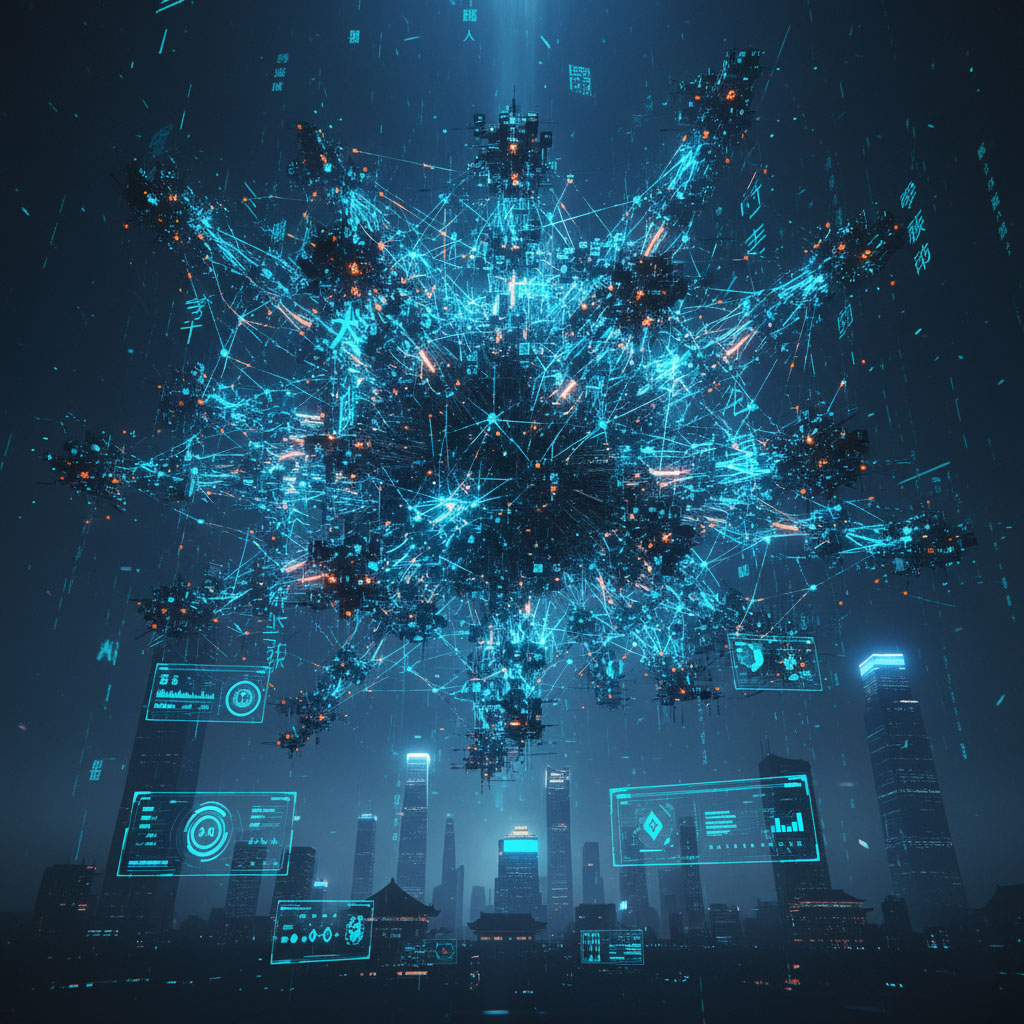
Developed by Moonshot AI and released in January 2026, KIMI K2.5 introduces agent swarm orchestration—a paradigm where a single orchestrator can instantiate and coordinate up to 100 specialized sub-agents working in parallel. This isn’t merely multitasking; it’s autonomous task decomposition with distributed execution.
Here’s the mechanics: When you submit a complex request—say, analyzing 100 different YouTube niches to identify top creators—the orchestrator doesn’t process sequentially. Instead, it spawns 100 independent search specialists, assigns one niche to each agent, and synthesizes results as they complete. What would take days of manual research or hours of sequential AI processing completes in minutes.
The system executes up to 1,500 tool calls in a single session, with each sub-agent capable of 100 steps maximum while the main agent maintains 15-step oversight. This architecture achieves a 4.5x efficiency improvement over single-agent configurations through what Moonshot calls Parallel Agent Reinforcement Learning (PARL).
Crucially, there are no predefined agent types. The orchestrator dynamically creates domain-specific agents based on task requirements. Competitive analysis spawns different agents for financial data, technical specifications, and market positioning. The system learns to balance breadth (many agents) versus depth (thorough investigation) based on task characteristics.
This represents a fundamental shift from reactive AI to proactive AI—systems that don’t just respond to prompts but autonomously strategize execution.
The Technical Breakthrough: Parallel Agent Reinforcement Learning
The innovation behind KIMI swarm isn’t just parallel processing—it’s the training methodology that prevents chaos when 50 agents execute concurrently.
Traditional reinforcement learning struggles with multi-agent attribution. When multiple agents act simultaneously, determining which decisions contributed to success or failure becomes mathematically ambiguous. Moonshot solved this through Parallel-Agent Reinforcement Learning (PARL), a staged training approach:
Stage One: Early training rewards parallel execution explicitly to prevent “serial collapse”—the tendency of orchestrators to default to single-agent execution when uncertain. The reward function incentivizes sub-agent instantiation and concurrent execution.
Stage Two: Later training shifts focus to task quality. The final reward balances completion quality (80%) with critical path efficiency (20%). This prevents artificial task splitting without performance benefit.
The system uses critical steps as its optimization metric—measuring the slowest sub-agent at each stage rather than total steps. This mirrors critical path analysis in project management: total runtime depends on the longest dependency chain, not the sum of all activities.
The result? KIMI swarm learned to autonomously determine when to parallelize versus when to consolidate. It understands that some tasks require deep sequential investigation while others benefit from broad parallel sampling.
This isn’t hardcoded logic. The orchestrator developed emergent strategies for task decomposition through training on approximately 15 trillion mixed visual and text tokens—a dataset that includes native multimodal content rather than text-only corpora with vision grafted later.
Benchmark Warfare: How KIMI Crushed US Competitors
The numbers don’t lie, and they tell a story of American complacency.
On BrowseComp—a benchmark testing information gathering across wide sources—KIMI swarm achieved 78.4% accuracy versus 60.6% for standard single-agent configurations. That’s a 29% improvement purely from parallelization.
But the real shock comes from cost-adjusted performance. Running these benchmarks cost Moonshot $0.27 versus $1.14 for Anthropic’s Claude Opus 4.5—a 76% cost reduction while maintaining competitive accuracy.
Consider the Humanity’s Last Exam (HLE-Full) benchmark, which combines text-based reasoning (31.5%) and image-based reasoning (21.3%) without tools. KIMI swarm achieved 50.2% with tool augmentation, compared to Claude Opus 4.5’s 43.2% and GPT-5.2’s 45.8%.
In coding benchmarks, KIMI K2.5 scored 76.8% on SWE-Bench Verified—real-world GitHub issue resolution—trailing only Claude’s 80.9% but at one-fourth the operational cost. On LiveCodeBench (competitive programming), it hit 85.0%.
The visual intelligence capabilities prove equally formidable: 78.5% on MMMU Pro (multimodal university-level problems), 84.2% on MathVision (visual mathematical reasoning), and 86.6% on VideoMMMU (temporal video understanding).
Here’s the strategic implication: Moonshot didn’t just match American frontier models—they surpassed them on agentic tasks while undercutting them on price, then released the entire architecture as open-source.
This is economic warfare disguised as technological innovation.
The Open Source Geopolitical Weapon
On January 20, 2026, Moonshot AI published KIMI K2.5’s weights on Hugging Face under a modified MIT license—permissive for commercial use, requiring only attribution. Within weeks, revenue from outside China surpassed domestic earnings as overseas users quadrupled.
This isn’t altruism. It’s strategic soft power projection.
By open-sourcing KIMI swarm capabilities, Moonshot achieves several geopolitical objectives simultaneously:
First, they accelerate global adoption of Chinese AI infrastructure, creating dependency on Beijing-controlled technological standards.
Second, they erode the competitive moat of American AI labs. When a capability this powerful becomes freely available, proprietary models lose pricing power and market share.
Third, they complicate Western sanctions and export control strategies. You can’t embargo open-source code that anyone can download and deploy locally.
The license itself is telling—”modified MIT” suggests potential compliance requirements or usage restrictions that could be activated later, particularly for military or surveillance applications. This creates a legal framework for Chinese state influence over global AI deployment.
Already, KIMI swarm ranks fourth on OpenRouter’s usage statistics—just days after launch—behind only Anthropic, Google, and DeepSeek. The open-source model is outperforming GPT-5.2 on agentic benchmarks while costing 44% less.
We’re witnessing the fragmentation of AI into competing geopolitical blocs: American proprietary systems (OpenAI, Anthropic, Google) versus Chinese open-source alternatives (DeepSeek, Qwen, KIMI). And the Chinese models are winning on accessibility and cost-efficiency.
Cybersecurity Implications: Your Data in the Swarm Era
Now we approach the critical concern: what happens when KIMI swarm technology becomes ubiquitous?
Traditional AI security focuses on single-model vulnerabilities—prompt injection, data poisoning, model inversion attacks. But swarm architectures introduce entirely new attack surfaces.
Supply Chain Compromise: With 100 agents potentially accessing external tools, APIs, and data sources simultaneously, the attack surface expands exponentially. Each sub-agent represents a potential compromise vector. If an adversary controls the orchestrator, they control a distributed army of intelligent agents.
Data Exfiltration at Scale: A compromised KIMI swarm could parallelize data theft across hundreds of sources simultaneously. Imagine 100 agents each extracting different segments of a proprietary database, then aggregating results through an external command-and-control channel.
Adversarial Agent Injection: Because the orchestrator dynamically creates agents based on task requirements, sophisticated attackers might craft prompts that spawn malicious sub-agents with elevated privileges or external connectivity.
Geopolitical Data Sovereignty: When you use KIMI swarm through Moonshot’s API, where does your data go? China’s Cybersecurity Law and Data Security Law mandate data localization and state access. Even “open-source” deployment doesn’t guarantee privacy if the underlying model contains telemetry or backdoor mechanisms.
The critical steps metric used in PARL training creates another vulnerability: attackers who understand the orchestrator’s optimization logic can craft tasks that maximize critical path length, effectively launching denial-of-service attacks against the swarm’s efficiency.
For enterprises, the risk calculation shifts. Using KIMI swarm offers 4.5x productivity gains at 76% lower cost—but potentially exposes sensitive data to Chinese jurisdiction and creates dependencies on infrastructure that could be weaponized during geopolitical crises.
This is the AI equivalent of Huawei’s 5G equipment: technologically superior, economically compelling, and strategically dangerous.
Comparative Analysis: KIMI vs OpenAI vs Claude
| Feature | KIMI K2.5 | Claude Opus 4.5 | GPT-5.2 |
|---|---|---|---|
| Agent Swarm | Yes (100 agents) | No | No |
| Benchmark Cost | $0.27 | $1.14 (76% higher) | $0.48 (44% higher) |
| BrowseComp | 78.4% | 65.8% | 59.2% |
| HLE with Tools | 50.2% | 43.2% | 45.8% |
| SWE-Bench Verified | 76.8% | 80.9% | 80.0% |
| License | Modified MIT (Open) | Proprietary | Proprietary |
| Deployment | Open-source/API | API only | API only |
The comparison reveals a clear strategic divergence. American labs optimize for peak single-task performance and proprietary control. Moonshot optimized for parallel efficiency and open distribution.
Claude Opus 4.5 maintains marginal advantages in pure coding tasks (80.9% vs 76.8%), but costs four times as much and lacks any swarm capability. GPT-5.2 leads in some reasoning benchmarks but falls behind on agentic tasks.
Neither American competitor offers anything comparable to KIMI swarm’s 100-agent orchestration. This isn’t feature parity—it’s architectural superiority in multi-task scenarios.
For developers and enterprises, the choice becomes: pay premium prices for proprietary black boxes, or adopt open-source alternatives with superior parallel capabilities but potential geopolitical baggage?
The Future of Agentic AI Warfare
We’re entering the swarm era of artificial intelligence.
The KIMI swarm release signals that agentic AI has evolved from research curiosity to production weapon. When 100 agents can coordinate autonomously, completing complex research, coding, and analysis tasks in minutes rather than hours, the productivity implications are revolutionary—and the security implications are terrifying.
Expect rapid escalation. OpenAI and Anthropic must either develop comparable swarm capabilities or cede the multi-agent market entirely. American export controls on chips become irrelevant when Chinese labs achieve superior efficiency through algorithmic innovation rather than compute scaling.
The open-source release ensures KIMI swarm will proliferate rapidly. We’ll see derivative models, specialized variants, and potentially malicious adaptations. The modified MIT license provides legal cover for widespread commercial adoption while preserving Moonshot’s ability to influence the ecosystem’s direction.
For nation-states, this technology enables unprecedented information warfare capabilities. Imagine 100 agents simultaneously analyzing social media sentiment, identifying influence targets, generating personalized propaganda, and measuring effectiveness—all autonomously coordinated.
For cybersecurity professionals, the threat model just became significantly more complex. Defending against single AI attacks was challenging enough. Defending against coordinated swarms of intelligent agents requires entirely new defensive architectures.
The KIMI swarm isn’t just a product. It’s a proof of concept demonstrating that Chinese AI labs can out-innovate American competitors on both capability and cost while leveraging open-source as a geopolitical force multiplier.
Silicon Valley built the AI revolution. Beijing may have just figured out how to mass-produce it.
The question isn’t whether you’ll encounter KIMI swarm technology. The question is whether you’ll control it—or be controlled by it.
- The AI Cybersecurity Threats No One Is Talking About in 2026
- China’s Tech War: Beyond the Chips and Into the Algorithms
- Open Source as Geopolitical Weapon: The New Arms Race
External Resources
- Official KIMI K2.5 Technical Blog – Moonshot AI’s official documentation
- KIMI K2.5 on Hugging Face – Open-source model weights
- Moonshot AI API Platform – Developer access and pricing
- KIMI K2.5 vs Top Models Analysis – Detailed benchmark comparisons
- Stanford DigiChina: How China Talks About Agentic AI – Academic geopolitical analysis
Last updated: February 7, 2026. This analysis reflects current capabilities as of the KIMI K2.5 release. Agent swarm technology evolves rapidly; subscribe for updates.
Comments (2)
AI Music Generatorsays:
February 7, 2026 at 7:34 amThe strategic advantage here seems clear: by making KIMI Swarm open-source, Moonshot AI has essentially lowered the barrier for anyone around the world to deploy powerful AI capabilities. I’m curious about how this could impact AI-related regulation and cybersecurity in the coming years.
demumusays:
March 11, 2026 at 6:25 pmThe idea of 100-agent swarm architecture being released as open-source is a game-changer—especially when you consider how it undermines the traditional AI development model that Silicon Valley has long dominated. It’s not just about speed or efficiency; it’s about shifting the balance of power in AI capabilities, making advanced systems accessible to a broader range of developers and organizations. This move could force a reevaluation of how we think about AI governance and data sovereignty in the global tech landscape.