


Gold price today just crossed $5,500 per ounce. If you’re checking your portfolio, you’re not alone-this is the biggest monthly gain since the 1980s.
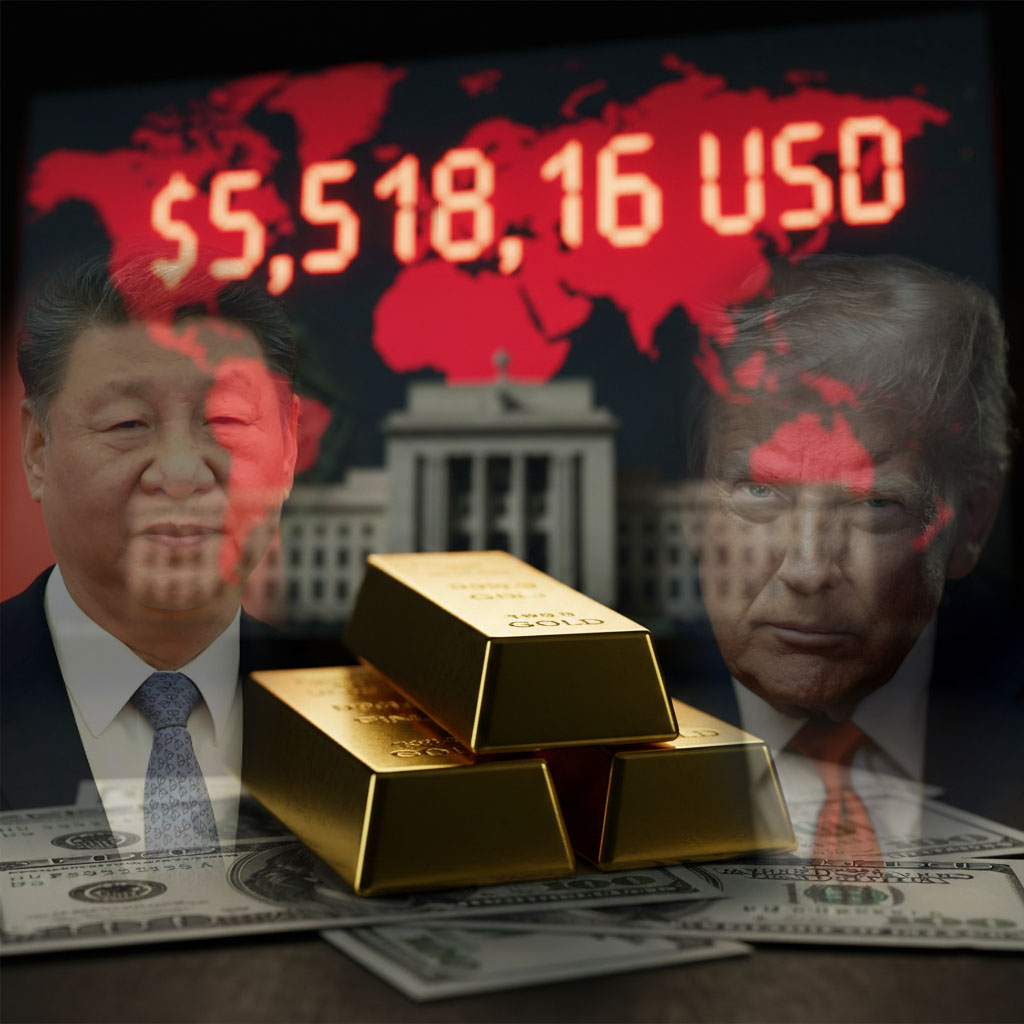
While Washington debates $3 trillion deficits and BRICS nations accelerate gold purchases to escape dollar dominance, the yellow metal has become the world’s voting machine. Central banks bought 297 tonnes in the first eleven months of 2025. January 2026 added another 60 tonnes. The Federal Reserve hasn’t increased gold reserves since 1971, but everyone else is stockpiling.
This is what happens when trust in fiat currencies fractures.
Gold Price Today: The Numbers That Matter
- Current Spot Price: $5,518.16/oz (24K)
- January 2026 Performance: +24% (Best month since 1980)
- 12-Month Return: +100%
- All-Time High: $5,555/oz (January 29, 2026)
The gold price today reflects more than supply and demand. It measures geopolitical anxiety, currency debasement fears, and the rising cost of holding paper assets in a multi-polar world. When Deutsche Bank raises its 2026 target to $6,000 and mentions $6,900 as “reasonable,” the paradigm has shifted.
Why Gold Is Exploding: Four Structural Drivers
1. BRICS Gold Grab: 70% by 2026
The 11-member BRICS bloc-Brazil, Russia, India, China, plus new members Egypt, Ethiopia, Iran, UAE, Saudi Arabia, and Indonesia-announced plans to control 65-70% of global gold reserves by 2026. They currently hold over 6,000 tonnes combined.
Russia leads with 2,336 tonnes. China holds 2,298 tonnes. India stores 880 tonnes. Since 2020, BRICS central banks increased gold allocation by 102%, accounting for over 50% of all global purchases.
Their stated goal: reduce reliance on dollar-denominated assets. Their method: relentless accumulation regardless of price. When central banks buy strategically rather than opportunistically, they remove supply from the market permanently.
2. US Fiscal Dominance: The $3 Trillion Hole
The Trump administration’s “One Big Beautiful Bill Act” is projected to expand the US budget deficit by over $3 trillion this decade. Under current trajectories, the deficit hits 7% of GDP.
When governments print currency to finance spending, gold price today becomes a real-time referendum on monetary credibility. Credit Agricole analysts note gold isn’t pricing “imminent crisis” but “persistent instability, heavy debt burdens, and eroding monetary trust.”
The Federal Reserve holds gold at $42.22 per ounce-statutory price from 1973. At today’s market price, the Treasury’s 8,133 tonnes are worth $1.44 trillion, not the $11 billion carried on books. The discrepancy says everything about currency debasement.
3. Geopolitical Arbitrage: Greenland to Gaza
Recent flashpoints-from US-China competition over Greenland to Russia-NATO tensions, Middle East instability, and Venezuela tensions-have created permanent risk premiums. Geopolitical arbitrage now favors hard assets over Treasury bills.
Gold price today responds to headlines in real-time. When approval ratings slide and midterm elections approach, policy uncertainty boosts safe-haven demand. The “America First” doctrine, while politically potent, accelerates de-dollarization among allies seeking alternatives.
4. Central Bank Panic Buying: 297 Tonnes
Official sector purchases averaged 17 tonnes monthly before 2022. Today: 60 tonnes monthly. Emerging market central banks-Turkey, Poland, Singapore, China-are diversifying reserves away from dollars and into bullion.
This isn’t portfolio adjustment. It’s structural reallocation. When central banks lose confidence in the reserve currency they collectively manage, gold price today becomes a leading indicator of monetary system stress.
Gold vs Dollar: The Correlation Breakdown
Historically, gold and the US dollar moved inversely. Strong dollar, weak gold. Weak dollar, strong gold.
That relationship broke in 2022-2023. Despite rising real interest rates (which theoretically hurt gold), prices climbed. Why? Structural demand from central banks and institutional investors hedging macro-policy risks created a new floor.
Gold price today reflects dual demand: traditional safe-haven flows during uncertainty, plus strategic accumulation by state actors building alternatives to the dollar system. Even if the dollar stabilizes in late 2026, gold’s role as neutral reserve collateral is now institutionalized.
2026 Forecasts: Where From Here?
| Institution | 2026 Target | Rationale |
|---|---|---|
| Goldman Sachs | $5,400 | Structural central bank demand |
| Deutsche Bank | $6,000 | US fiscal dominance concerns |
| UBS | $6,200 | H1 2026 momentum |
| Societe Generale | $6,000 | Multi-polar world demand |
Morgan Stanley’s bull case: $5,700. Credit Agricole’s conservative estimate: $5,100 average for Q4 2026. Even bears expect gold to remain above $5,000 throughout the year.
Silver & Platinum: The Co-Movement
Gold price today isn’t an isolated phenomenon. Silver hit $121.64/oz-a 60% monthly gain driven by supply shortages and industrial demand. Platinum reached $2,918.80. Palladium trades near $2,000.
The entire precious metals complex is repricing. When gold leads, silver follows with leverage. For investors, the gold-silver ratio (currently 46:1) suggests silver remains undervalued relative to historical norms.
The Bottom Line
Gold price today measures the velocity of trust erosion. When central banks abandon dollars for bullion, when deficits exceed $3 trillion, when geopolitical tensions become permanent rather than cyclical, gold becomes the denominator.
The BRICS 70% target by 2026 isn’t just an ambition-it’s a countdown. Every tonne they acquire reduces floating supply. Every dollar printed by Washington increases relative scarcity.
For American investors, gold price today isn’t a number on a screen. It’s a referendum on fiscal policy, a hedge against currency debasement, and insurance against geopolitical fragmentation.
The 1980s saw the last comparable surge. That ended with 20% interest rates and Volcker’s recession. This time, the Fed can’t hike without bankrupting the Treasury. The gold price today reflects that trap.
Stay gold. Stay hedged.
-KingSankalpa Protocol-
Gold Price Today: Critical Questions
What is the gold price today in USD?
Gold price today is approximately $5,518.16 per ounce (24K), though prices fluctuate throughout trading hours. Check the live widget above for real-time updates.
Why is gold price today so high?
Four structural drivers: BRICS central banks targeting 70% global reserves, US deficits exceeding $3 trillion, geopolitical tensions (Greenland, Middle East, Russia-NATO), and institutional hedging against dollar debasement.
Will gold price today reach $6,000?
Major banks including Deutsche Bank, UBS, and Societe Generale forecast $6,000+ by end of 2026. Goldman Sachs targets $5,400. Even conservative estimates expect gold to remain above $5,000 throughout the year.
Which countries are buying the most gold?
BRICS nations (Russia: 2,336 tonnes, China: 2,298 tonnes, India: 880 tonnes) plus Turkey, Poland, and Singapore. Central bank purchases averaged 60 tonnes monthly in 2025-far above the 17-tonne pre-2022 average.
Is the US dollar losing value against gold?
Yes. Gold price today reflects 100% gains over 12 months while the US Dollar Index hovers near multi-month lows. The traditional inverse correlation has strengthened as central banks diversify away from dollar reserves.
Comments (1)
Nano Banana AIsays:
January 31, 2026 at 9:37 amWith all this central bank buying and the BRICS nations pushing for a shift away from the dollar, it’s clear that gold is emerging as a safe haven. I’m curious to see how this geopolitical shift will reshape global trade and currency systems in the coming years.