


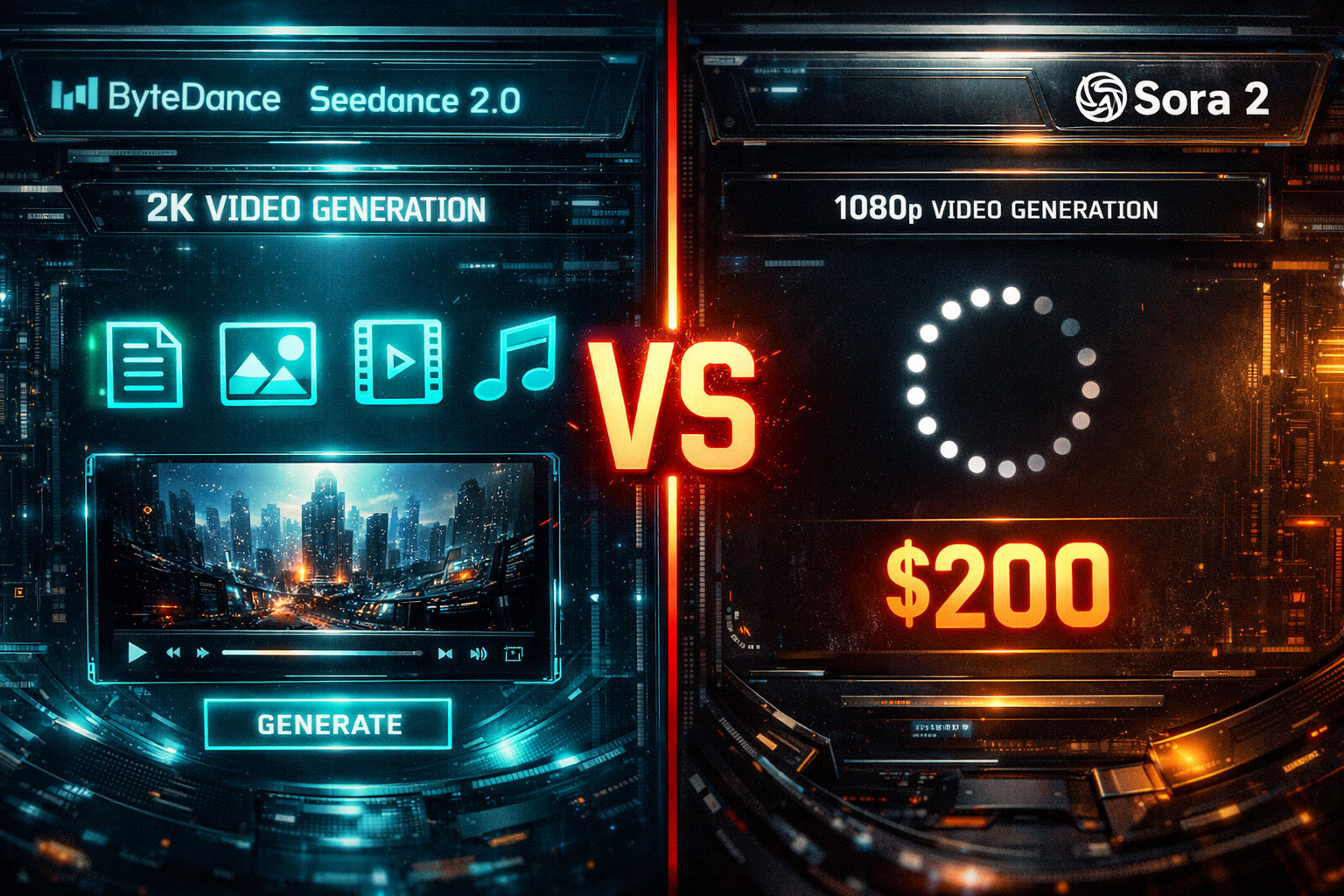
⚠️ MARKET DISRUPTION ALERT: ByteDance just executed the most aggressive pricing maneuver in AI video history. While OpenAI charges $200/month for Sora 2, Seedance 2.0 delivers superior 2K resolution at 90% lower cost-starting at $9.60/month. This isn’t competition. This is economic warfare.
Published: February 19, 2026 | Reading Time: 9 minutes | Classification: Creator Intelligence
Table of Contents
- The Pricing Disruption: $9.60 vs $200
- Technical Supremacy: 2K Native + Quad-Modal Input
- Speed War: 30-Second Generation vs 5-Minute Waits
- The Quad-Modal Advantage
- Benchmark Carnage: Seedance vs Sora vs Kling
- The TikTok Distribution Moat
- Complete Pricing Breakdown
- Director Mode: Real-World Domination
- The Verdict: Sora is Dead
The Pricing Disruption: $9.60 vs $200
On February 24, 2026, ByteDance didn’t just launch another AI video generator. They detonated a pricing bomb that renders OpenAI’s Sora 2 economically indefensible. While Sora 2 demands $200/month for advanced access, Seedance 2.0’s premium tier costs just $9.60/month (69 RMB) through Jimeng [^45^]. That’s not a discount-that’s demolition.
The free tier alone provides 60+ daily credits-enough for 15-30 seconds of video generation. Sora 2 offers no meaningful free tier [^43^]. For creators operating at scale, the cost differential is catastrophic: $104,280 annual savings when switching from Sora Pro to Seedance Advanced [^43^].
ByteDance isn’t competing. They’re executing a scorched-earth pricing strategy designed to starve Western competitors of revenue while capturing the global creator economy.
[adsense_in_content]
Technical Supremacy: 2K Native + Quad-Modal Input
Seedance 2.0 doesn’t just undercut competitors on price-it surpasses them on specifications. The model outputs native 2K resolution (2048×1152), doubling Sora 2’s 1080p maximum [^40^]. For creators producing content for large displays or high-definition advertising, this isn’t incremental improvement. It’s qualitative superiority.
The technical architecture reveals ByteDance’s strategic intent. Seedance 2.0 employs a Dual-Branch Diffusion Transformer with Latent Consistency Model (LCM) acceleration-reducing inference steps while maintaining quality [^35^]. This isn’t research-grade optimization. It’s production-grade efficiency designed for TikTok’s billion-user scale.
Resolution comparison tells the story:
- Seedance 2.0: 2K native (2048×1152), 1080p standard [^40^]
- Sora 2: 1080p maximum (1792×1024 Pro tier) [^40^]
- Kling 3.0: 4K/60fps (but limited to 10-second clips) [^47^]
- Veo 3.1: 4K (enterprise pricing only) [^39^]
But resolution without control is meaningless. Seedance 2.0’s Director Mode provides shot-level control-camera angles, character positioning, lighting adjustments-previously requiring professional cinematography skills [^41^].
Speed War: 30-Second Generation vs 5-Minute Waits
Generation latency determines whether AI video feels magical or frustrating. Seedance 2.0 generates a 5-second 1080p clip in 30-90 seconds [^32^]. Sora 2 requires 60-300 seconds for equivalent quality-and up to 10+ minutes during peak usage [^32^].
The speed advantage stems from ByteDance’s infrastructure moat. Their GPU clusters-originally built for TikTok’s recommendation algorithms-now power generative video at consumer scale [^32^]. OpenAI’s infrastructure struggles with Sora’s computational demands, resulting in unpredictable queue times.
For real-time applications-social media responses, live event coverage, trending topic monetization-Seedance’s speed advantage translates directly to revenue. While Sora users wait, Seedance creators publish.
[adsense_in_content]
The Quad-Modal Advantage
Here’s where Seedance 2.0 achieves categorical differentiation. While competitors offer dual-modal input (text + image), Seedance processes four modalities simultaneously: text, image, video, and audio [^36^].
Practical implications:
- Audio Reference Input: Upload a music track; Seedance generates video synchronized to the beat [^36^]
- Video-to-Video: Upload reference footage; Seedance replicates camera movement and choreography precisely [^36^]
- Multi-Image Consistency: Input up to 9 reference images for character consistency across scenes [^47^]
- Phoneme-Level Lip-Sync: 8+ languages with precise mouth movement synchronization [^42^]
Sora 2 accepts text and image. Kling 3.0 accepts text, image, and limited video. Only Seedance 2.0 processes all four modalities natively-enabling workflows impossible for competitors [^40^].
The native audio generation deserves particular attention. Seedance 2.0 produces synchronized sound effects, ambient audio, and dialogue simultaneously with video generation [^36^]. No post-production required. No separate audio tools. One prompt, complete multimedia output.
Benchmark Carnage: Seedance vs Sora vs Kling
| Metric | Seedance 2.0 | Sora 2 | Kling 3.0 |
|---|---|---|---|
| Max Resolution | 2K (2048×1152) | 1080p (1792×1024) | 4K/60fps |
| Max Duration | 15 seconds | 25 seconds | 10 seconds |
| Input Modalities | 4 (Text/Image/Video/Audio) | 2 (Text/Image) | 3 (Text/Image/Video) |
| Native Audio | ✅ Yes | ✅ Yes | ❌ No |
| Generation Speed (5s clip) | 30-90 seconds | 60-300 seconds | 45-120 seconds |
| Entry Price | $9.60/month | $20/month (limited) | ~$10/month |
| Pro Price | $84/month | $200/month | ~$50/month |
| Free Tier | 60+ credits/day | Very limited | Limited |
| Character Consistency | 95%+ | Moderate | Strong |
Source: Aggregated from APIYI technical benchmarks, WaveSpeedAI analysis, and official documentation [^40^][^47^][^32^]
The scoring reveals strategic positioning: Seedance dominates resolution, multimodal input, speed, and pricing. Sora leads in physical realism and maximum duration. Kling excels at high-frame-rate output but lacks audio capabilities.
For commercial creators-advertising, social media content, product demos-the combination of 2K resolution, quad-modal input, and 95% character consistency makes Seedance 2.0 the production-ready choice [^43^].
The TikTok Distribution Moat
Technical specifications mean nothing without distribution. Here’s ByteDance’s killer advantage: they own the platform.
OpenAI must partner with platforms. ByteDance is the platform. With TikTok and Douyin, they control:
- Creator onboarding and workflow integration
- Algorithmic distribution and viral amplification
- Ad monetization infrastructure
- Consumer engagement feedback loops [^35^]
This creates a vertically integrated pipeline: Prompt → Generation → Auto-edit → Distribution → Algorithmic Boost → Revenue Attribution [^35^]. No Western AI video company owns this full loop.
The strategic implication: Seedance 2.0 isn’t a standalone model. It’s infrastructure embedded directly into the world’s most powerful short-form distribution network. Generated videos flow seamlessly into CapCut editing suites, then directly to TikTok’s algorithm [^43^].
For creators, this means zero friction from concept to viral distribution. For competitors, it means competing against a company that monetizes AI video at the platform level-not just the generation level.
[adsense_in_content]
Complete Pricing Breakdown
Seedance 2.0 accessibility varies by platform-each offering different credit structures and feature sets:
| Platform | Entry Cost | Pro Cost | Key Features |
|---|---|---|---|
| Jimeng (Dreamina) | Free (60 credits/day) | 69 RMB (~$9.60)/mo | Full ByteDance ecosystem integration |
| Xiaoyunque | Free (promotional) | Free (limited time) | Zero-cost generation during promo period |
| Third-Party APIs | Free trial credits | ~$0.10-0.80/min | Enterprise integration, multi-model access |
| Sora 2 (Comparison) | $20/mo (limited) | $200/mo | Superior physics, longer duration |
Source: GamsGo pricing analysis and official platform documentation [^38^][^45^]
Cost-per-video analysis reveals the economic devastation: a 10-second video costs $1.91-$4.60 on Dreamina versus significantly higher effective costs on Sora 2 when accounting for generation failures and queue times [^39^]. For high-volume production, Seedance reduces operational costs by 80% compared to first-generation AI video tools [^45^].
Director Mode: Real-World Domination
Seedance 2.0’s Director Mode transforms prompt engineering into cinematography. Instead of praying for coherent output, creators specify:
- Camera Movements: Pan, tilt, dolly, crane shots with precise timing
- Character Blocking: Positioning, movement paths, interaction choreography
- Lighting Schemes: Key light direction, fill ratios, color temperature
- Scene Transitions: Cut timing, fade duration, match cuts [^41^]
Real-world production scenarios:
E-commerce Product Videos: Input product images + brand audio track. Seedance generates 15-second lifestyle footage with consistent lighting and camera movement-ready for TikTok Shop ads.
Music Video Production: Upload track + reference footage. Seedance replicates choreography with phoneme-perfect lip-sync-production time reduced from weeks to hours.
Short-Form Content Farms: Batch generate 100 variations of a winning concept with consistent characters but different scenarios-impossible with Sora’s variable output.
The 90%+ generation success rate means creators spend time editing, not regenerating [^45^]. This reliability transforms AI video from experimental toy to production infrastructure.
The Verdict: Sora is Dead
Seedance 2.0 doesn’t just compete with Sora 2. It renders Sora 2 economically obsolete for 95% of use cases.
The combination of 2K resolution, quad-modal input, 30-second generation speed, and $9.60 pricing creates a value proposition OpenAI cannot match without destroying their own margins [^40^][^43^]. While Sora 2 maintains advantages in physical realism and maximum duration, these matter primarily for high-end cinematic production-a niche market compared to the content creation tsunami Seedance enables.
ByteDance’s distribution moat seals the competitive fate. When generation cost approaches zero and distribution is instant, technical marginalia become irrelevant. Seedance 2.0 isn’t just a better AI video generator. It’s the infrastructure for the next billion creator economy.
For individual creators: Seedance 2.0 offers professional capabilities at consumer prices. For studios: The 80% cost reduction on wasted generations transforms ROI calculations. For platforms: Integration with TikTok’s algorithm creates viral potential no competitor can replicate.
The AI video wars are over. ByteDance won.
The only question remaining: how long before OpenAI admits defeat and matches pricing-or exits the consumer market entirely?
- KIMI K2.5: The 100-Agent AI Swarm Devastating Silicon Valley – ByteDance isn’t alone in the China tech offensive
- China’s AI Ecosystem: The Full Stack Assault
External Resources
- Seedance 2.0 Official – ByteDance official documentation
- Jimeng (Dreamina) – Primary access platform
- Sora 2 Documentation – OpenAI official specs
- WaveSpeedAI Benchmarks – Technical comparison data
Last updated: February 19, 2026. Pricing and features reflect current Seedance 2.0 capabilities. Market conditions in AI video evolve rapidly.
Comments (9)
Yes Nano Bananasays:
February 23, 2026 at 10:50 amIt’s fascinating to see how Seedance 2.0 is reshaping the AI video landscape not just with its pricing, but with real-world usability like the 2K resolution and quad-modal input. The $9.60/month tier alone makes it accessible for creators who were previously priced out of tools like Sora 2. The speed and cost advantages really highlight a shift in who can participate in AI-generated video creation.
Wan AIsays:
February 23, 2026 at 11:16 amSeedance 2.0’s 2K resolution and faster video generation really set it apart. With such a dramatic price difference, it’ll be interesting to see if other platforms can catch up—especially as more creators at scale start flocking to Seedance for its technical and economic advantages.
Yes Nano Bananasays:
February 23, 2026 at 11:46 amThe $9.60/month pricing for Seedance 2.0 really shifts the playing field—especially for creators who’ve been priced out by Sora 2’s $200/month model. It’s not just about cost, but how this move could democratize AI video creation and force other players to reconsider their strategies. The technical edge with 2K resolution and quad-modal input only adds to the disruption.
Yes Nano Bananasays:
February 23, 2026 at 1:36 pmThis breakdown really highlights how Seedance 2.0 is shifting the power dynamic for creators, especially with that $9.60/month pricing compared to Sora 2’s $200. It’s not just about cost—it’s about accessibility and scalability for a broader audience. The 2K resolution and quad-modal input also seem like strong differentiators that could influence adoption. The real question now is whether this pricing move will push other players to reconsider their own strategies.
Yes Nano Bananasays:
February 23, 2026 at 1:37 pmThe $9.60/month pricing for Seedance 2.0 really shifts the playing field—especially when you consider the 2K resolution and quad-modal input capabilities. It’s not just about cost savings; it’s a clear signal that AI video tools are becoming more accessible to creators at scale. The comparison with Sora 2’s $200/month model highlights how quickly market dynamics can change when a competitor challenges the status quo.
Yes Nano Bananasays:
February 23, 2026 at 1:41 pmIt’s fascinating to see how Seedance 2.0 is reshaping the AI video landscape not just with its pricing, but with real-world usability like the 2K resolution and quad-modal input. The $9.60/month model really puts pressure on competitors to rethink their value propositions. For creators, the cost savings alone make this a game-changer, especially when you factor in the free tier credits.
Yes Nano Bananasays:
February 23, 2026 at 3:19 pmThis pricing move by ByteDance really shifts the dynamics for creators who’ve been priced out by Sora 2’s $200/month model. The 2K resolution and quad-modal input seem like solid technical upgrades too, which makes the cost difference even more striking. It’ll be interesting to see how this affects adoption and whether other platforms follow suit.
Yes Nano Bananasays:
February 23, 2026 at 3:47 pmThis pricing move by ByteDance really shifts the dynamics for creators who’ve been priced out by Sora 2’s $200/month model. The $9.60 tier alone offers a compelling free credit allowance that makes it accessible for smaller creators or those testing the waters. It’s not just about cost—it’s about democratizing access to high-quality AI video generation.
demumusays:
March 10, 2026 at 10:53 amThe $9.60/month pricing for Seedance 2.0 really shifts the playing field—especially when you consider the free tier offers 60+ credits daily. It’s not just about cost anymore; it’s about accessibility and scalability for creators. This move forces the market to rethink what AI video tools can realistically offer.